Why 2025 Feels Like a Turning Point for Artists of the African Diaspora and Global South
2025 marks a quiet turning point — not of explosive growth, but of maturity. The contemporary art market is finding balance again, and in that balance, new voices are rising.

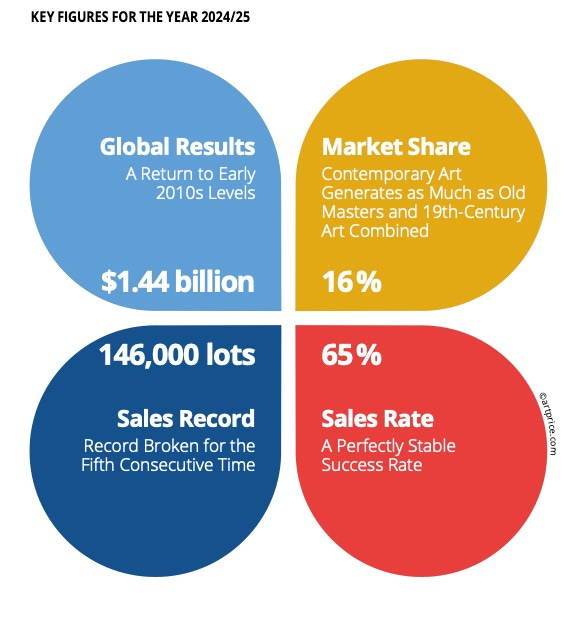
Key Figures for the Contemporary Art Market, 2024/25 — Contemporary art generated $1.44 billion in auction turnover across 146,000 lots, accounting for 16% of the global art market with a stable 65% sales rate. After several volatile years, these results signal a return to early-2010s levels and a more sustainable equilibrium.
(Source: Artprice Contemporary Art Market Report 2025)
Author’s Note
Every year, I read the Artprice Contemporary Art Market Report not just for the numbers, but for the signals — those subtle shifts that show where culture, value, and collector behavior are actually converging. The data tell one story; the context tells another.
For those of us who’ve been tracking the rise of artists from the African diaspora and Global South, this year’s report confirms something we’ve felt intuitively: the market is maturing, and the balance of power is widening. Collectors are getting smarter, institutions are catching up, and the next wave of opportunity is already taking shape.
Let’s get into it.
The Market Has Found Its Balance
After a correction cycle that started back in 2022, confidence is returning.
According to Artprice, contemporary art generated $1.44 billion in auction turnover across 146,000 lots, making up 16 percent of the global art market with a healthy 65 percent sales rate.
That’s not hype — that’s equilibrium.
It’s the art world’s version of an exhale after years of speculation.
And the real momentum is in the $25K–$250K range (Artprice identifies the mid-market segment roughly between $10,000 and $300,000; this analysis focuses on the $25K–$250K range, where liquidity and cultural momentum are strongest.) — a space that’s dynamic, liquid, and increasingly home to artists from the diaspora and Global South. It’s where many collectors are finding opportunities to acquire culturally resonant, investment-grade work before the broader market catches up.
A note on scope:
The Artprice Contemporary Art Market Report 2025 looks at the secondary market — auction resales, not primary-market gallery sales. Those auction trends often validate what’s already happening on the primary side, usually with a one- to two-year lag.
So when we see diaspora and Global South artists performing well at auction, it means the groundwork — institutional support, curatorial visibility, collector confidence — is already solid.
A Market That’s Widening, Not Just Deepening
Yes, the U.S., U.K., and China still dominate the numbers. But look closer and you’ll see the spread.
France continues to rise as a European hub, driven by strong auction results and international fair presence. Japan and South Korea are gaining traction, powered by an increasingly sophisticated base of Asian collectors. And even though Artprice doesn’t yet track the sub-Saharan market in detail, we can see parallel growth in Lagos, Accra, and Cape Town, where gallery ecosystems and collector networks are expanding fast.
This global rebalancing isn’t a blip — it’s structural. Artists and collectors outside the traditional centers are helping to shape what’s next.
Who’s Driving Demand
Artists from the diaspora remain front and center.
The speculative highs of 2021–22 have cooled for artists such as Amoako Boafo, Toyin Ojih Odutola, and Kudzanai-Violet Hwami — yet what’s emerged is a more mature, sustainable market for their work, driven by institutional validation and collector discernment. Collectors are gravitating toward artists who are expanding the language of painting and sculpture through material experimentation, identity, and community.
Artprice also highlights the continued rise of female artists, who now account for a growing share of auction turnover. Artists like Julie Curtiss, Jadé Fadojutimi, and Christina Quarles exemplify that momentum — proof that collectors are looking for work that fuses personal narrative and visual innovation.
